


All our articles
Active wintering – Winterize your pool
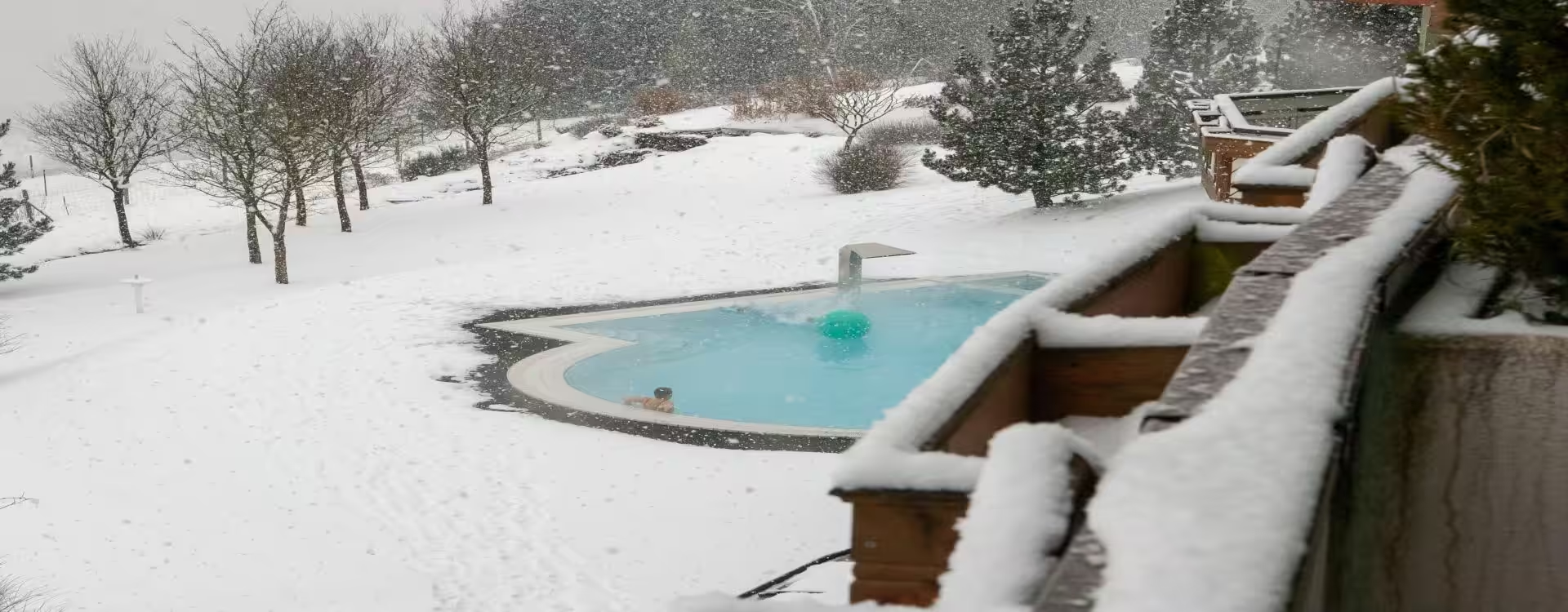
What is active wintering?
During the cold season, it is essential to maintain your pool, as the filtration system remains operational. Adopt active wintering to take care of your pool, by continuing to clean the pool (in the absence of a cover) and by keeping an eye on the filtration system. In this article, you will learn how to maintain your water quality and protect your pool as well as its equipment.
Start active wintering when the water temperature drops below 12°C.
Above this temperature, algae, microbes, and viruses are likely to develop. In general, active wintering is recommended for pools in regions where the winter is mild. Pool owners equipped with a heat pump with defrosting or an anti-freeze device should prioritize active wintering.Warning: water tends to freeze especially at night; if you do not have a heat pump or an anti-freeze device and nights are close to 0°C, it is preferable to opt for passive wintering.
- In the absence of an anti-freeze device and during a freezing period, run the filtration in forced mode.
- It is no longer necessary to treat your pool, but always monitor the water pH.
- If you do not have a cover, continue to clean your pool: the bottom, the walls, and the skimmer baskets.
- Similarly at night, when temperatures are cooler, you can run the filtration continuously… or install an anti-freeze device.
- In the event of a particularly harsh winter, plan for the possibility of power outages; this could result in high repair costs.
- If a layer of ice forms on your pool, there is a risk that the skimmers will suck air from under the ice, which could prime the pump… If this happens, the system will have to be stopped; there is no other choice.
- Do not attempt to break the ice, as you could damage the liner. If the freezing period is more severe than expected, you can switch from active wintering to passive wintering.
The anti-freeze device
A temperature alarm, generally set around 0°C, allows the anti-freeze device to automatically trigger the pump when this temperature is reached.
Steps to establish active wintering:
step 1: pool cleaning
Clean the bottom and walls using a robot, especially if there are algae. Remove the robot and store it in a sheltered place. Clean the skimmers and empty the baskets.
step 2: filter cleaning
After the filter has captured the water impurities, perform a backwash then rinse, before putting the filter back in the filtration position. Don’t forget to clean the pre-filter basket.
step 3: stopping chemical treatments
Suspend automatic water treatments, it is not necessary to chemically treat water that is below 12°C.
step 4: water analysis
Check the water parameters and make corrections if needed. The pH must be maintained between 7 and 7.4 during wintering.
step 5: shock chlorination
Perform a shock chlorination if the water quality is insufficient or if the chlorine level is too low.
step 6: wintering product
Add a wintering product, fungicide and anti-limescale, two days later.
step 7: cover the pool
Clean the shutter or winter cover and fix it on the pool deck. Although covering is not mandatory, without protection, the pool will require regular cleaning.
step 8: anti-freeze device
Install or activate your anti-freeze device, which will run the filtration if the water temperature drops too low. The water must not freeze, either in the pool or in the pipes.
Step 9: Program the filtration
Set the clock on the electrical device that controls the filtration. The filtration time is generally one-third of the water temperature. For example, for water at 6°C, plan for 2 hours of filtration per day.
Step 10: Monitoring
It’s finished, your pool is ready for winter. However, continue to monitor the pH and water temperature.
 Tablier PVC seul
 Coffret Alimentation 24V Hors Sol
 Coffret Alimentation 24V Immergé
 Contacteur à clé
 Télécommande
 Bouchon à coller PVC
 Capuchon de lame PVC
 Sangles et attaches de piscine
 Turbine de nage – Intégrée
 Turbine de nage – Saillie amovible