


All our articles
Swimming pool excavation: advice and steps
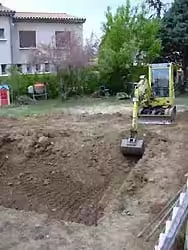
Swimming pool earthworks: our advice
Pool location
It is crucial to place your future swimming pool in a way that directs natural rainwater drainage away from the basin, in order to prevent heavy rain from filling your pool.
Adjust the sloping ground to promote proper water runoff: the pool must be located at least 12 to 15 cm above the ground. This will allow for the creation of a gentle slope from the terrace. Avoid letting gutter water flow near the basin, as this could saturate the soil or fill the excavation.
Choose a location for the pool where it can benefit from maximum sunshine.
Planning
Prepare some rope, stakes, and marking spray.
For a pool to be installed 3 meters from a house.
Place two temporary stakes in the ground, the first 3 meters from one end of the house, the second 3 meters from the other end.
Stretch a rope between these two stakes and extend it to the boundaries of your property or to points far from any foot traffic.
Let’s call these points x and y. The line between x and y will serve as a reference. Since x and y are far from any future traffic, this line can be used to align the steel wall during construction.
To locate the first corner of the pool, choose a point on line xy.
Drive a stake into the ground at this location and call it A.
Measure from point A along line xy a distance equivalent to the length of the pool, then drive a stake at this new location which we will call B.
For the other two corners: from point A, measure perpendicularly at 90 degrees to line xy, a distance equal to the width of the pool.
Drive a stake at this location, which we will call C.
Repeat this process from point B and call this new point D.
Verify that the distance between C and D is identical to that between A and B.
To guarantee that the angles at the four corners are square, ensure that the lengths AD and BC are equal.
If the pool has rounded corners, repeat this calculation for each corner:
For a rounded corner with a radius of 0.60 m, measure 0.60 m from a corner stake along the length of the pool and place a stake there. Do the same along the width and install another stake. Using two ropes attached to each stake, find their intersection point, located 0.60 m inside the large rectangle. Drive a third stake at this intersection. With a rope attached to this last stake, trace a quarter circle (with a radius of 0.60 m between stake 1 and stake 2).
Repeat this method for each corner, then mark the straight lines and arcs with your marking spray.
You will thus have delimited the location of your future basin.
To transform the pool layout into an excavation layout, simply draw a new perimeter surrounding the first one at a distance of 60 cm. This space will be useful for positioning the supports surrounding the panels.
Free-form pool
Whatever its shape, the pool always possesses a theoretical rectangle that contains it, with the largest dimensions being the length and width. With this rectangle defined, you will be able to determine points serving as centers to sketch the arcs that will give shape to the pool.
Earthworks
Once…
Before starting the excavation after having traced precisely, several preparations are essential:
1. Ensure that site access is clear by removing the fence and placing boards on the edges to limit damage to outdoor spaces.
Move plants and check that all necessary permits are in order with the urban planning departments (you must make a work declaration at the town hall).
2. It is necessary to determine the level, i.e., the elevation of the pool. If you do not have an established benchmark, use a site level to measure the soil elevation in at least four places, corresponding to the four corners of the traced area.
Use the highest point as a reference and mark it.
Transfer this benchmark to a fixed location in the garden (such as a fence post or a wall) in order to keep this reference and use it to check the site level during operations.

3. Once you have established the elevation, it is time to mark the level of the bottom of the wall and the lowest point of the pool.
For the bottom of the wall, measure 1.12 m above your reference. This level corresponds to the shallow end and the ledge on which the pool walls will be installed. For the maximum depth, measure 1.60 m above the ledge marker, for a total of 2.75 m above your benchmark. Attach adhesive tape to the benchmarks to indicate the ledge and maximum depth.
4. After marking these levels, remove the sod along the excavation layout with a shovel.
In high-traffic areas, place stakes flush with the ground at intervals of 4.30 to 5.50 m to help locate the edge of the excavation in case marks are erased by the machinery.
Rent a mechanical shovel or hire an earthmover to carry out the excavation.
Start with the shallowest part and dig down to the desired pool level.
Define the boundary between the shallow end area and the start of the deep area using a marking spray.
This will help the driver keep a straight line during the transition to the deep part.
Continue excavation along the pool walls at the same depth as the shallow area.

Once one part is level on one side, mark the start of the side slope.
Measure 60 cm inward from the excavation line (see diagram).
With a plumb line, transfer this point to the level part and mark the line with paint.
The driver can then remove the excess soil.
To guarantee the proper slope of the side wall, measure 1.20 m from the edge of the slope towards the inside of the excavation.
Use the plumb line to transfer this point to the bottom of the excavation.
Use a shovel and a pickaxe to level the side slopes. It is important to remove any unstable soil and to level the ground well.
After removing all the soil, check all measurements and mark the flat surface and the edge that will support the walls. It is crucial to faithfully follow the dimensions presented in your earthwork plan.
If a bottom drain for pool drainage is planned, identify the center of the deepest area and dig a hole of 45 x 60 cm for the sump.
For sandy soil, it is preferable to create a wider ledge to provide better stability for the panels. Remove the excess after cementing the base.
Rocks or shale require specific equipment (rock breakers).
Excess water also requires the placement of a layer of crushed stone in the excavation. It is necessary to dig a wider depression to accommodate this layer of gravel. The gravel facilitates water flow without causing the edges of the excavation to collapse.
The installation of a suction valve connected to a pump allows water to be drained from the excavation during the work.
The amount of backfill to keep will depend on the variation in garden height and the degree of slope modification.
Next step: Installing panels and structure
 Tablier PVC seul
 Coffret Alimentation 24V Hors Sol
 Coffret Alimentation 24V Immergé
 Contacteur à clé
 Télécommande
 Bouchon à coller PVC
 Capuchon de lame PVC
 Sangles et attaches de piscine
 Turbine de nage – Intégrée
 Turbine de nage – Saillie amovible