


All our articles
What water color for your swimming pool?
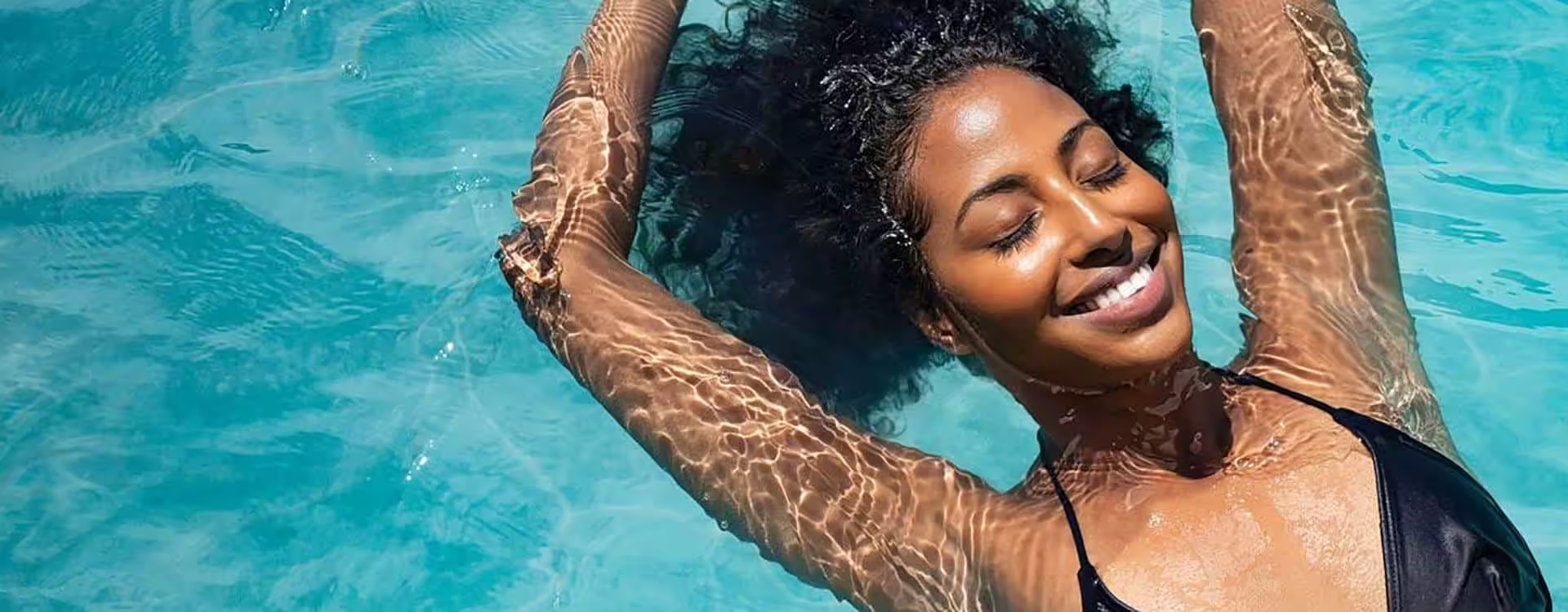
Impact of luminosity and weather conditions on water tint
Water acts as a mirror and reflects the sky, which is why it generally appears blue. Luminosity and weather conditions strongly influence the color of water in a swimming pool: the water tint is mainly affected by these three elements:
- The time of day;
- The time of year;
- The level of sunshine.
In summer, on sunny days, a leisure pool usually has a clear and vibrant tint. However, this color naturally varies on rainy days or according to the hour. On the other hand, the water in a natural pool is often green, generally because of its environment.

Is there a link between the liner and the color of a swimming pool’s water?
The liner does not directly change the color of your pool water. It only influences your perception! For example, if the liner is blue, your pool water will naturally look blue, and turquoise if the bottom is light-colored. If your liner is yellow and the sky is blue, you will observe a tint close to emerald green, while a grey liner will reveal a wide range of blue shades.
It is important to note that the color of your pool water also depends on the depth and shape of the bottom. A larger surface reflects more light, while a greater depth gives a certain density to the color.
Water tints that reveal problems
- Milky white;
- Green;
- Brown, red, dark yellow, or black.
What does whitish or milky water mean?
When your pool water takes on a whitish or milky tint, it means it contains a high level of limescale. The presence of white algae and a malfunctioning filtration system can also be responsible. To reduce water hardness, use an anti-limescale product intended for swimming pools and clean the basin.
If algae are present, apply an anti-algae treatment, then use a flocculant to eliminate dead algae residues. In case of filtration system failure, the filter will also need to be replaced.
Does green water indicate dirt?
If your pool walls are slippery and the water is green and cloudy, it indicates a proliferation of green algae due to insufficient pool or filter maintenance, or an inappropriate product dosage. The green color can also be due to corrosion.
To solve this problem, use a fungicide or anti-algae product, clean or replace the filter, and ensure you maintain the pool well.
What to do if the water is brown, red, or black?
These tints signal a high level of metal ions, particularly iron or manganese. An excess of iron generally leads to a brown, red, or dark yellow tint, while a high level of manganese causes a brown or black coloration.
These colors can appear after the first chlorine treatment (as these metals oxidize on contact with chlorine). To help the water regain its normal tint, it is advisable to perform a shock chlorine treatment. You can also add a flocculant to your pool.
The color of the pool water can vary depending on the weather and sunlight. These variations are not dangerous if the pool maintenance is carried out correctly. However, certain colors may indicate that the water is not clean and requires treatment. If this is the case, high-quality products are available to treat and clean your pool!
 Tablier PVC seul
 Coffret Alimentation 24V Hors Sol
 Coffret Alimentation 24V Immergé
 Contacteur à clé
 Télécommande
 Bouchon à coller PVC
 Capuchon de lame PVC
 Sangles et attaches de piscine
 Turbine de nage – Intégrée
 Turbine de nage – Saillie amovible