


All our articles
Pool water balancing: a guide
Achieving Pool Water Balance
How does water balancing work?
Adjusting the water balance of your pool can be a complex and laborious task depending on several specific factors. Among these elements, pH is one of the best known because it is crucial for users, but other factors are also essential and can impact swimming as well as chemical consumption.
pH and TAC of pool water
The pH indicates the level of acidity or alkalinity of the water and should be between 7.2 and 7.6. The TAC (Total Alkalinity) reflects the water’s ability to neutralize acids, with a recommendation of between 80 and 120 ppm (parts per million).
Hardness and chlorine levels
Water hardness concerns the concentration of calcium, which must be maintained between 200 and 400 ppm. The level of chlorine, a disinfecting agent, must be kept between 1 and 3 ppm.
Temperature and filtration, keys to balancing
The ideal pool water temperature ranges from 26 to 28°C. Adequate filtration is essential to eliminate impurities and guarantee clear and pleasant water. It is also important to check that the filtration time is properly adapted.
In addition, alkalinity, which indicates the water’s ability to resist changes in pH, must be between 80 and 120 ppm. The chemicals used to treat the water must correspond to the specific needs of your pool.
What tools to control water balance?
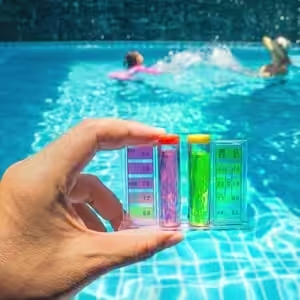
Test kits, such as reagent strips or drop tests, allow for the assessment of water parameters. It is advisable to perform these tests at least once a week in order to maintain a correct balance and ensure the water quality of your pool.
What are the ideal values for each parameter?
- pH between 7.2 and 7.6
- TAC between 80 and 120 ppm
- Hardness between 200 and 400 ppm
- Chlorine between 1 and 3 ppm
- Alkalinity between 80 and 120 ppm
What are the consequences of water imbalance?
Water imbalance can lead to algae proliferation, making the water cloudy and greenish. This can also cause filtration and disinfection problems. A phenomenon of over-chlorination can occur when using an electrolyzer combined with a pool cover. Swimmers may then experience skin irritation, red eyes, breathing difficulties, as well as headaches due to water imbalance.
Restoring the right balance through appropriate treatments
Are you familiar with the Taylor method? It is a precise measurement tool for water parameters. Applying appropriate chemicals helps overcome imbalances and ensures quality water. In the event of a pH imbalance, it is essential to measure its level and adjust it using specific products, such as pH Plus or pH Minus.
How to obtain good…
Pool water
To maintain a good water balance in your pool, follow these steps: it is essential to regularly monitor the chlorine level and make adjustments if necessary to guarantee an optimal concentration.
It is also vital to perform a regular check of the pool water Redox.
- Perform frequent checks of the chlorine level: Regularly check the amount of chlorine and adjust it if necessary to ensure an optimal concentration.
- Check the pH and TAC to maintain adequate alkalinity and prevent algae: By keeping the pH and TAC within the desired levels, you can avoid algae growth and guarantee clear and healthy water.
- Monitor water hardness and temperature: It is crucial to frequently evaluate water hardness and temperature to ensure that equipment is functioning properly and that the water remains pleasant for swimmers.
The benefits of well-balanced pool water
First of all, you will enjoy a more pleasant swim. Balanced water offers a swimming experience without irritation to the eyes, skin, or respiratory tract.
You will also succeed in reducing your maintenance costs and chemical consumption. Well-balanced water makes chemicals more effective.
Finally, you will consume less water. Balanced water reduces algae and turbidity problems, thus limiting the need to replace water and allowing for resource savings.
Frequently asked questions about water balancing
Why balance pool water?
It is essential to balance pool water to guarantee the health and comfort of swimmers, as well as the durability of equipment. Balanced water helps maintain the clarity and cleanliness of the water, avoid algae and turbidity problems, prevent irritation of the eyes, skin, and respiratory tract, and optimize the effectiveness of chemicals. Moreover, a good water balance helps reduce long-term maintenance costs and preserve the environment by limiting water consumption.
How to adjust the pool pH?
To adjust the pool pH, start by measuring it using a test kit. If the pH is too low (acidic), you can add pH Plus to increase it. If it is too high (alkaline), add pH Minus to decrease it. Carefully follow the manufacturer’s recommendations for dosage and check the pH again after adding the chemicals.
What role does alkalinity play on pH?
Alkalinity acts as a buffer that stabilizes the pH and protects it against rapid variations. A good alkalinity level contributes to keeping a stable pH and prevents fluctuations that could harm water quality and equipment. If alkalinity is too low, pH can undergo frequent variations. If it is too high, it may become difficult to adjust the pH.
The T.H. of my pool water is too high, what should I do?
The T.H. (Hydrotimetric Title) indicates water hardness, representing the concentration of calcium ions.
and magnesium. Water that is too hard can cause scale deposits on the walls and pool devices, as well as cloudy water. If the T.H. of your pool is too high, here are some actions you can take to lower it:
- Dilution
: The simplest method to lower the T.H. consists of diluting the pool water by adding fresh water. You can remove part of the pool water and replace it with fresh water having a lower T.H. This approach is particularly effective if the difference in T.H. between the pool water and the fresh water is significant. - Use of a water softener
: If your water supply source is naturally hard, you can use a water softener to decrease the T.H. before filling or topping up the pool water. These devices work by replacing calcium and magnesium ions with sodium ions, which reduces water hardness. - Use of a calcium sequestrant
: Calcium sequestrants are chemicals that bind to calcium ions and prevent them from depositing as scale. They can be added directly to the pool water and are particularly effective at preventing scale deposits on surfaces, equipment, and the waterline.
 Tablier PVC seul
 Coffret Alimentation 24V Hors Sol
 Coffret Alimentation 24V Immergé
 Contacteur à clé
 Télécommande
 Bouchon à coller PVC
 Capuchon de lame PVC
 Sangles et attaches de piscine
 Turbine de nage – Intégrée
 Turbine de nage – Saillie amovible