


All our articles
Swimming pool drainage: when and how to do it
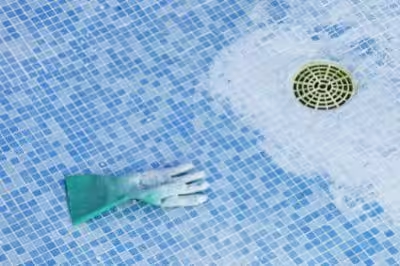
Emptying your pool: when and how?
It is not necessary to completely change your pool water every year. With proper maintenance, you can keep it for several years. However, water that has become “outdated” will be increasingly difficult and expensive to manage, so it is advisable to completely drain your pool occasionally, when the water is too “old” or in the face of specific problems.
Why drain your pool?
Several reasons may lead you to carry out a full drain of your pool:
- If, after returning from vacation or after wintering, you notice that your pool water is cloudy and opaque, and your treatment and disinfection efforts have failed to restore its clarity, a full drain may then be necessary.
- Similarly, if the water becomes cloudy due to a heavy accumulation of residues, particularly chlorine treatments that release stabilizers into the water, it is advisable to change the water, at least partially. This overload could indeed harm the effectiveness of chlorine, which would eventually lead to insufficient protection against algae and bacteria.
- The presence of limescale is also a reason that can justify draining. Although it is normal to see scale deposits appearing on the walls and bottom of your pool, a gray crust should alert you because these limescale deposits promote the accumulation of algae and waste that harm the water’s cleanliness. It is therefore better to empty the pool in order to treat the walls with an appropriate descaling product.
- Draining will also be necessary if work is planned in the pool: replacing tiles, shell repairs or liner replacement, or even restoring a coating…
- Other problems may also require replacing the water, totally or partially, such as an excessive pH imbalance or too high a concentration of metals (iron or copper) in the water.
Even if none of the cases mentioned above occurs and you maintain your pool with care, salts eventually accumulate in the water. These nitrates and chlorides resulting from the degradation of chlorine disturb the water balance and can damage metal elements, and only draining will allow you to get rid of them.
When to drain your pool?
- Frequency of draining: Public pools must be drained twice a year, but there is no regulation for private pools. It is generally advised to partially renew the water every year, while a full drain can be carried out every 3 or 4 years.
- Which period to choose? It is important not to drain a pool lightly. Although spring is considered the ideal time to benefit from fresh water at the start of the sunny season, you must also take environmental factors into account to determine the date: water-saturated soil will not be able to absorb this surplus and risks causing flooding or subsidence due to excessive pressure from the surroundings on the empty pool. Late summer can therefore be a viable option, or any other period when groundwater levels are low and the soil is dry.
How to proceed with draining?
A pool
It is important to inquire about the rules in force in your municipality regarding the disposal of pool water. Some cities require that water be discharged through the sewers, while others allow it on your own property.
- Disposal into the sewers: In theory, according to the decree of June 3, 1994, it is forbidden to discharge pool water into the public sewer system without authorization, in order to avoid overloading wastewater treatment plants. You must therefore request authorization from local authorities, such as the town hall or the prefecture, and a sanitation tax may be required. Once you have obtained this authorization, simply connect your pool to the sewer network using a hose.
- In some cases, you may be advised to spread the water on the ground. In this case, you will need to stop water treatments at least one week before draining to avoid polluting the soil, or use a chlorine neutralizer. It is best to do this during a period when the soil is dry, and to drain the pool slowly so as not to flood the land, especially on a slope. Also remember to notify your neighbors so they can be attentive, and know that you will be responsible in the event of untimely runoff onto their property.
- If these options cannot be implemented, if you fail to obtain authorization, or if soil that is too saturated or a specific geographical configuration prevents you from carrying out these operations, you can always call on a draining professional or even store part of the water, once cleared of its chemical treatments, to water your garden!
Emptying a pool, a few precautions to take
The pool structure is subject to high pressure from the soil, generally balanced by the weight of the water in the pool. When draining, and especially if the soil is already saturated with water, this pressure can cause movement or deformation of the pool walls. Under this pressure, your shell can crack or your liner can form irreparable wrinkles. It is therefore essential to ensure that the pool remains empty for as little time as possible: reduce the duration of the work and, if draining is necessary to restore balance or water cleanliness, leaving 30 cm of water at the bottom of the pool will not hinder maintenance tasks. In the case of a liner, use a vacuum setup to hold the lining in place and try to eliminate any wrinkles with a brush when refilling it. In case of doubt or special circumstances, do not hesitate to call a professional who will ensure that the drainage takes place without damage to your equipment.
Remember to secure the empty pool, as it can represent a risk for children and animals who might approach it. Also be careful not to slip during handling operations, whether around or in the pool, and do not hesitate to wear a helmet to protect yourself in case of a fall!
Discover our pool pumps
 Tablier PVC seul
 Coffret Alimentation 24V Hors Sol
 Coffret Alimentation 24V Immergé
 Contacteur à clé
 Télécommande
 Bouchon à coller PVC
 Capuchon de lame PVC
 Sangles et attaches de piscine
 Turbine de nage – Intégrée
 Turbine de nage – Saillie amovible