


All our articles
Installing pool kit panels: a practical guide
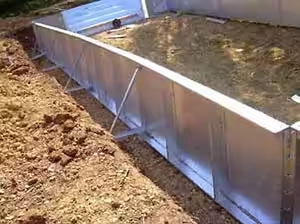
Installing the panels of a swimming pool kit
Before starting, check the inventory list to ensure all components are present on-site.
Using the diagram, identify the precise shape and position of the panels (the drawing is generally included in the kit).
Drive metal stakes into the ground to mark the placement of the steel panels.
Mark the outline that the panels will follow during installation using spray paint.
Lay out the panels around the excavation, placing those with the skimmer and return fittings in their designated locations.
Position the A-frame braces around the pool so they are easily accessible during panel assembly.
Keep the nuts and bolts in a bucket, within easy reach.
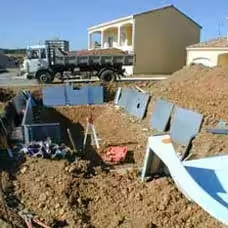
Begin assembly with a corner panel.
Add the straight panels and continue until you have gone around the entire pool.
This way, the panels remain upright without the need for additional supports, unless the wall is too long. In such a case, it may be necessary to connect the panels to prevent them from leaning inward toward the excavation.
Curved panels stand upright with minimal reinforcement.
Bring two panels together. Use a drift pin to align the holes in the panel flange. With hand clamps or pliers, hold the panels in place, which will allow you to position the bolts without assistance. Ensure that the face and top of the panels are correctly aligned. Insert the bolts and tighten them.
Check that each panel is correctly positioned using the stakes as references.
Drive a rebar through each hole at the base of the panels to secure them. Repeat this process until all panels are securely assembled with bolts. You can start by installing only 3 bolts at the ends. The remaining bolts will be added when installing the A-frames and deck supports.
Once all panels are assembled, check all dimensions.
Add the A-frame braces and deck supports.
Secure the panels and A-frames using a stake.
At this stage, walk around the pool to ensure all bolts are properly tightened.
Important: if the pool includes stairs, fix the panel to the edges with a hand clamp, taking into account the height of the coping.
Drill holes through the panel and the stair flange. Insert the bolts and tighten them.
Install the step supports.
Leveling the panels
Set up the bubble level. Based on the reference mark, determine the height of the top of the panels and mark a reference point with marking paint.
Walk around the pool and measure the height of the panels. The difference between the highest and lowest of these heights will help you choose the thickness of the shims (bricks) to use for adjustments.
Always start at the highest point to begin leveling. To do this, use a pry bar, bricks, and shims. Lift the wall until it reaches the desired height, then place enough shims under the wall at a panel joint to maintain the correct elevation. Lightly tap the wall to ensure it is stable and to reduce soil settling. Recheck the height. In unstable or sandy soils, it is advisable to place a cinder block under the panel joint and use shims. This will help minimize settling and the movement of fragile soils. It is recommended to place shims under each panel. For a rectangular pool, start by leveling the four corners, then adjust the sides. Once these panels are bolted, they will be rigid enough to span the entire length with minimal sagging. Ensure that all panels are level around the pool and verify the height once more.
### Vertical alignment of the kit
Using a level, ensure that the face of the panel is perfectly vertical. It is possible to place a shim behind each A-frame brace. Raising the back of this support tilts the panel toward the pool, while lowering it tilts it in the other direction. When the panels are correctly leveled and straight, drive stakes into the holes at the back of the A-frames. These stakes will keep the panels in place during the concrete pour. The number of stakes required varies depending on the type of soil; you will need fewer stakes in clay soils than in sandy soils.
### Marking the slopes
To do this, use string, metal stakes, and a site level. For a slight slope, identify the two extreme points at the start of the slope. Drive a rebar at each point, then stretch a string to represent the upper level of the screed. For the deepest area, repeat the same method: locate the two extreme points, drive metal stakes into the ground, and stretch a string between these two stakes. The string will indicate where the concrete level will be at the bottom of this deepest part of the pool.
For the slopes of the side walls, measure 1.20 m from the base of the steel panel. Use a plumb line to transfer this height toward the bottom of the deepest area. Place a metal stake in the ground up to the projected height of the concrete. Repeat this process until the bottom of this zone is fully marked out. For the sloping sides, pull a string between the stake on the shallow side and the one on the deep side. This string will symbolize the slope formed between the bottom and the sides of the pool. For freeform or rounded pools, the same objective can be achieved using multiple stakes. The string is more practical for rectangular pools.
The stakes will serve as markers during the concrete pour, which will be leveled to the same height as the stakes and strings. Drive the stakes into the concrete with a hammer. You can use tape or a marker to indicate the concrete height on the base of the steel panels, which will help achieve a uniform slope all around the pool. For the liner to fit properly, it is essential to follow all specified dimensions.
### Before backfilling
Before proceeding with backfilling, install a grounding system (copper braid and stake to be driven into stabilized ground) to discharge residual currents, especially if you are using a salt chlorinator or other electrochemical treatment device.
### Next step: Concrete pouring and bottom screed
 Tablier PVC seul
 Coffret Alimentation 24V Hors Sol
 Coffret Alimentation 24V Immergé
 Contacteur à clé
 Télécommande
 Bouchon à coller PVC
 Capuchon de lame PVC
 Sangles et attaches de piscine
 Turbine de nage – Intégrée
 Turbine de nage – Saillie amovible