


All our articles
Plumbing and technical room installation
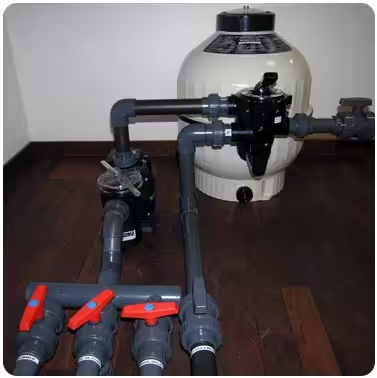
Plumbing Installation and Technical Room
It is advisable to evaluate the hydraulic needs for each pool. This will help determine the pump power and the essential diameters to ensure ideal pool operation. It is recommended to completely renew the water every 4 hours, which requires a flow rate of 15m3/h for a 60 m3 capacity.
The diameter of the pipes connecting the skimmer must be at least 50 mm.
Regarding polyethylene pipes: these pipes are the most commonly used. They offer great flexibility and are easy to handle. Their use is discouraged if they are exposed to sunlight, as ultraviolet rays can deteriorate this material over time.
Polyethylene pipes come in large rolls, facilitating installation with a minimum number of fittings.
Tracing the Pipeline
Pipes must be laid in trenches and excavations free of stones or sharp objects. Use sand or clean soil as backfill.
It is important to mark the trenches to prevent stakes from being driven into the ground near the pipes.
When installing the deck, it is essential to avoid pipes crossing each other. Do not place conduits on unconsolidated soil. Pipes should not overhang A-frame supports (struts) or empty areas. They must be laid along their entire length.
Provide a transition ramp between the trench and the excavation. It is impossible to bend a pipe at a right angle. If it is kinked, replace it to prevent leaks.
The conduits between the pool and the filtration system can be installed in two ways.
The most common method consists of installing the pipes at the level of the fittings. This requires partial backfilling up to the height of the fittings, then making the connections, and finally backfilling to the desired level.
This approach is only recommended if the backfill consists of materials not prone to settling, such as gravel. If the pipes are connected before backfilling, it is crucial to surround them properly to ensure they remain straight and supported.
The second method consists of positioning the pipes at the base level of the walls. This will result in vertical rises along the walls to the fittings.
When pouring concrete, the conduits must be encased in concrete. This encasement protects the conduits from settling and accidental damage while minimizing frost risks. This technique requires the installation of rising columns to ensure proper installation.


Lighting Installation
The ideal time to install lighting devices integrated into the wall is during pipe laying (if your pool kit is not already pre-drilled).
If an opening is already factory-cut, installation will be simple. Otherwise, follow these steps if you must make the opening yourself. Start by using the spotlight gasket to trace the outline of the opening on the steel panel with a marker. Drill a point in the center of the circle. With an electric saw equipped with a metal-appropriate blade, cut along the traced line until the circle is fully released. Ensure the spotlight fits correctly. Apply a cold galvanizing product (spray) to the cut edges or cover them with anti-rust paint. Then install the spotlight and place a conduit to protect the wiring. The latter must be installed by a licensed electrician and comply with current standards.
Installation of Sealing Components
Start by installing the return fittings. Remove the locking nut located at the back of the fitting. Insert it into the cut opening on the pool side. Then screw the locking nut onto the back of the fitting and tighten it using multi-grip pliers. Mount the adapters onto the fittings, which will allow the threaded or solvent ports to adapt to the polyethylene conduits.
Threaded Fittings
Use Teflon tape or a specific sealant for plastic fitting threads. Screw the adapters into the fittings starting by hand, then with a wrench or pliers. Please do not overtighten. It is advisable to use rigid PVC tubes rather than softer polyethylene fittings.
Glued Fittings
Some fittings require gluing the adapters. In this case, it is essential to apply PVC glue. Start by cleaning and preparing the adapter as well as the inside of the fitting. Apply glue to the inside of the fitting in circulation, taking care not to let glue penetrate too far into the socket. Coat the end of the adapter with glue. Insert it by turning it at least a quarter or half turn to ensure uniform glue distribution on the contact areas. Hold the fitting in place for a few seconds to allow the glue to begin bonding.
For polyethylene conduit:
This conduit is available in 30 m and 75 m rolls. Unroll it so that it places itself correctly. Examine the conduit to check its condition.
Start establishing the connections. Begin by laying the skimmer conduit in the excavation and trench.
Connect the skimmer. Place two stainless steel clamps at the end of the conduit, making sure to orient the tightening screws in opposite directions to ensure uniform tension during tightening. Repeat this operation for each fitting on all conduits.


Technical Room
A saw
Cutting polyethylene conduits is simplified with a tool adapted for metals. It is important to make clean cuts at a 90-degree angle to facilitate subsequent assembly. Polyethylene conduits can be quite rigid, especially when it is cool, which makes connecting more complicated. Sometimes, forcing a conduit onto a fitting can cause it to break. To remedy this, it is advisable to heat the end of the conduit using a propane torch.
It is best to keep the torch at a distance of 15 to 30 cm from the conduit, moving the flame in circles until the material becomes flexible. Be careful not to leave the flame too long in the same spot, as this could cause a fire or deform the plastic. Once the conduit is sufficiently malleable, slide it onto the fitting without forcing. Hold it for a few moments while it cools to regain its rigidity. This technique is also applicable to barbed fittings such as couplings, T-fittings, and elbows.
To tighten the clamps properly, follow these steps:
- Position the first clamp with the screw facing you at the top.
- Install the second clamp with the screw facing you at the bottom.
- Use a screwdriver to alternately tighten the upper clamp and the lower clamp.
- Once all connections are made, check that all clamps are tight. As the conduit cools, it contracts; loosen the clamps if necessary.
To finalize the pipeline installation, using rising columns may be necessary to connect the conduits in the trench to the equipment. Consider creating a template for each connection, which will facilitate passing the rising columns through the concrete base.
Regarding PVC piping, rigid and flexible PVC conduits are used, with all fittings being glued. The assembly method is similar to that used for polyethylene conduits, without tightening clamps. To connect the conduits, start by applying a primer to all surfaces to be glued, then apply a good layer of glue to both surfaces. Then fit the conduits together by turning them while pushing one into the other, and hold the connection until the glue hardens.
Be sure to choose the appropriate glue: glue for rigid PVC differs from that for flexible PVC. In other words, you can use flexible glue for rigid conduits but not the other way around.
Stair Installation
If the stairs are equipped with hydrojet or return nozzles, it will be necessary to drill holes using a hole saw of the correct diameter. The nozzles and inlets are equipped with two gaskets that you must place on each side of the risers. Ensure the locking nut is tightened well. You can then connect the conduits to the circulating water systems. Before proceeding with burial, carry out a pressure test on the entire pipeline.
Before Backfilling
Attach a grounding device to the metallic structure (copper braid and stake to be driven into stabilized ground) before proceeding with backfilling to discharge residual currents if using a chlorinator or other electrochemical treatment devices.
Next step: Waterproofing, water filling, and backfilling.
 Tablier PVC seul
 Coffret Alimentation 24V Hors Sol
 Coffret Alimentation 24V Immergé
 Contacteur à clé
 Télécommande
 Bouchon à coller PVC
 Capuchon de lame PVC
 Sangles et attaches de piscine
 Turbine de nage – Intégrée
 Turbine de nage – Saillie amovible