


All our articles
Pool Maintenance – 3 Tips for Clean Water
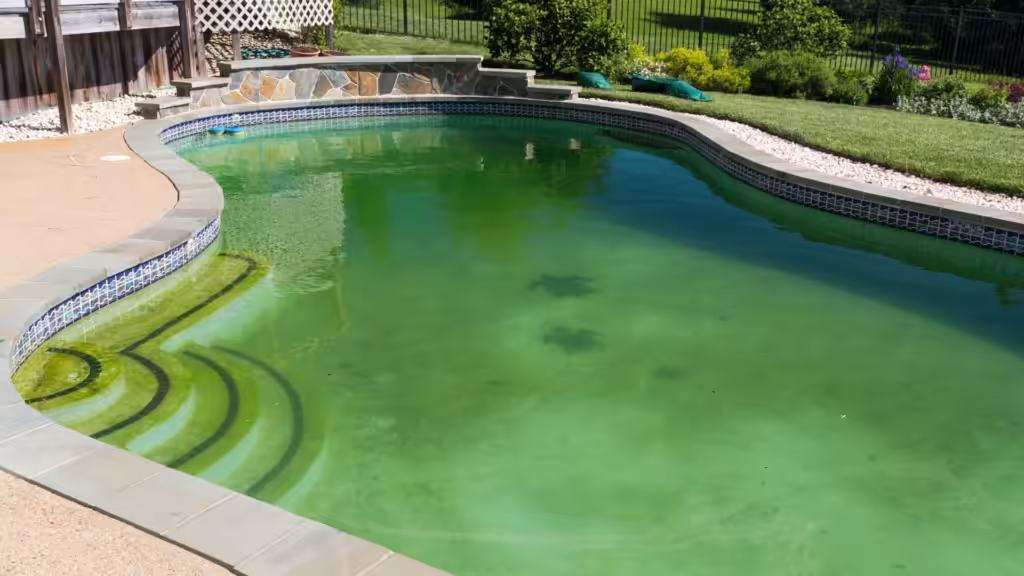
Your pool water can be influenced by several external elements, such as pollution, rain, temperature changes, and UV rays. These factors directly impact the water quality of your pool.
To fully enjoy your pool while minimizing maintenance, a few simple tips can make a difference. Three essential aspects directly affect water cleanliness and quality: filtration, disinfection, and pH level.
In this guide, we detail these essential points to ensure healthy and clear water. We will also mention other treatment methods, such as salt electrolysis.
If you need specific solutions for your pool maintenance, take a look at our summary of different signs indicating a need for intervention at the end of this article.
1. Pool Filtration
The filtration is decisive, acting as the lung of your pool by refreshing the water and preserving its quality. For best results, filter your pool daily for 8 to 12 hours continuously. During heatwaves or periods of heavy use, extend the filtration time, especially during the day when needs are increased.
👉 Here is a simple rule to estimate the daily filtration time: Filtration time (in hours) = Water temperature (in °C) ÷ 2
The filtration system includes a pump and a filter. The pump draws water from the pool to send it to the filter, which captures debris and impurities.
Once filtered, the clean water returns to the pool, but it is not yet completely healthy. It still contains microorganisms, algae, and microscopic fungi. This is where water treatment comes in, ensuring swimming in healthy water that is safe for health.
2. Water Treatment
The dosage of the disinfectant for your pool is fundamental to ensure risk-free swimming. Regularly check the chlorine level using a test kit or strips to obtain accurate results. This will allow you to precisely adjust the chlorine dosage.
For more peace of mind, we recommend using an automated treatment system, such as salt electrolysis or an automatic chlorine regulator (Redox). These systems guarantee continuous and precise control of your water parameters, ensuring optimal quality.
3. Pool Cleaning
A regular maintenance of your pool is crucial to maintain clean and healthy water, thus providing a pleasant and safe swimming experience.
Daily Pool Cleaning
The rule is quite simple: the more you take care of your pool, the simpler its maintenance becomes. Constant maintenance will guarantee good control of your water quality and preserve the condition of your equipment. When the pool is not in use, remember to cover it with a tarp to prevent leaves from falling in.
If you do not have a filtration system, as is often the case for certain above-ground pools, use a landing net to remove leaves, insects, and other visible debris. Do not forget to check the water level. The ideal level should be halfway up the skimmers. A water level that is too low can lead to the deactivation of your pool pump, which can cause damage.
the engine of the latter.
Thorough Weekly Pool Cleaning
Step 1 – Cleaning the waterline
- Use a specific gel for the waterline or a “magic” sponge.
- If the waterline is heavily soiled, increase the water level above the line, then perform a chlorine shock treatment to remove fatty residues.
Step 2 – Vacuum and pool robot
- Use the vacuum or your pool robot to effectively clean the bottom and walls of your pool.
Step 3 – Chlorine Check
- In the absence of a chlorine regulator or automatic treatment system, regularly check the chlorine level with test strips or a water analysis kit.
Step 4 – pH Control
- Without an automatic pH regulator, evaluate the pH level. The ideal is between 7.2 and 7.4 to guarantee pleasant swimming and optimal disinfectant effectiveness.
Step 5 – Filter Maintenance
- For sand filters, perform a backwash in order to eliminate impurities.
- For cartridge filters, clean them with a water jet. If needed, you can wash them in the dishwasher for a deep clean. In case of persistent dirt, consider replace the filter. Most cartridge filters are easily available as spare parts.
Step 6 – Cleaning the skimmer and the pump
- Empty the basket or the filter sock of your skimmer.
- Check that your pump’s pre-filter is not clogged and empty it if necessary.
Summary of Symptoms of Poor Swimming Pool Maintenance
Discover below the common problems related to pool water as well as the solutions to remedy them.
Green Pool Water, Appearance of Algae on the Bottom and Walls of the Basin
We recommend performing a shock chlorination of your pool. Then, clean and rinse your filter, place a flocculant cartridge in the skimmer and use an anti-algae product, while ensuring that it is compatible with your treatment system.
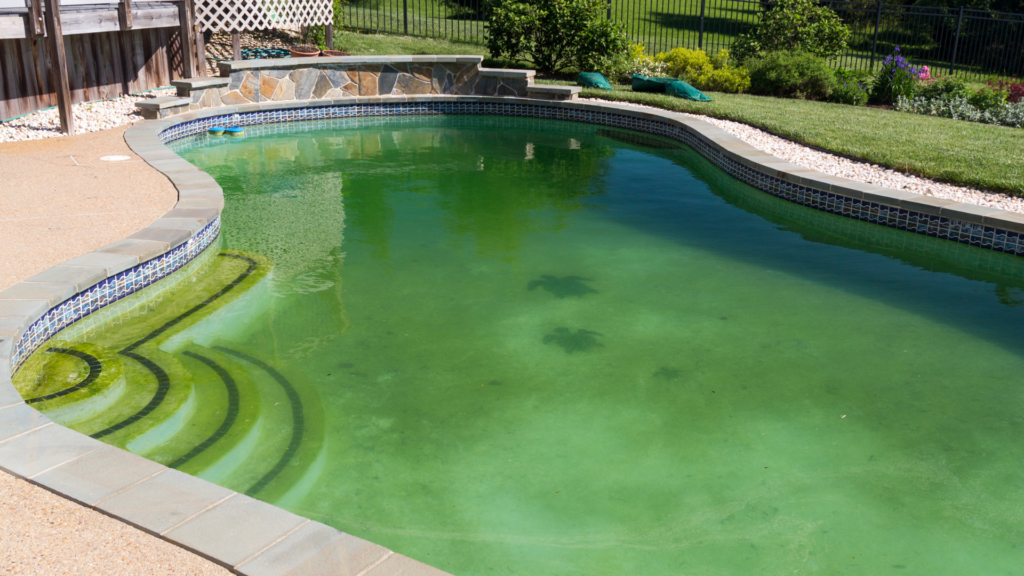
⚠️ Warning: avoid using a flocculant if your filter is equipped with a cartridge.
Green and Translucent Pool Water
If your pool water is green and translucent, this could signal the presence of copper. To remedy this situation, use a metal sequestrant, which will help to neutralize the copper and clarify the water.
Milky or Cloudy Pool Water
If your pool water appears milky or cloudy, this may be due to:
- Improper pH dosage: To correct this, check it using a test kit or an electronic pH tester. The pH should be between 7.2 and 7.4. If not, adjust it with a pH correction product (pH+ or pH-). If the water does not become clear again, perform a shock chlorination.
- Insufficient chlorine level: Perform a shock chlorination, use a flocculant to bundle together particles that are too fine, then perform 3 successive backwashes. Finally, run your filtration system continuously for 24 hours.
- Dirty filter: Check the pressure of your sand filter. Most manufacturers recommend a pressure below 1.5 bars. If the pressure is above this, it means your filter is clogged.
- Suspended impurities: Increase the filtration fineness by adding a flocculant.
- Algae formation: Adjust the pH, perform a shock treatment and proceed with a curative treatment.
Chlorine Smell, Eye and Skin Irritation
Surprisingly, this occurs when your pool’s chlorine level is too low. Simply perform a shock chlorination to increase the chlorine level, then readjust the pH between 7.2 and 7.4. To prevent this type of inconvenience, we recommend opting for a salt electrolysis treatment system.
Everything You Need to Know About Pool Maintenance
Do you own a pool and want to know more about its maintenance?
Discover our section dedicated to your pool maintenance.
 Tablier PVC seul
 Coffret Alimentation 24V Hors Sol
 Coffret Alimentation 24V Immergé
 Contacteur à clé
 Télécommande
 Bouchon à coller PVC
 Capuchon de lame PVC
 Sangles et attaches de piscine
 Turbine de nage – Intégrée
 Turbine de nage – Saillie amovible