


All our articles
Swimming pool construction guide #2: excavation and masonry
Now that you have identified the ideal location for your swimming pool and completed the necessary administrative procedures, you can begin the work. Every pool project follows a sequence of steps to be followed in order, as well as some best practices to adopt.
Excavation of the pool
First, it is essential to start with the excavation by digging a hole generally larger than the final dimensions by 50 to 60 cm, both in length and width. Additionally, remember to dig about 30 cm deeper.
Once the hole is made, it is important to lay a 10 cm layer of gravel (sub-base) at the bottom of the excavation before pouring the concrete slab. The sub-base is the concrete slab that ensures the ground will support the pool structure.
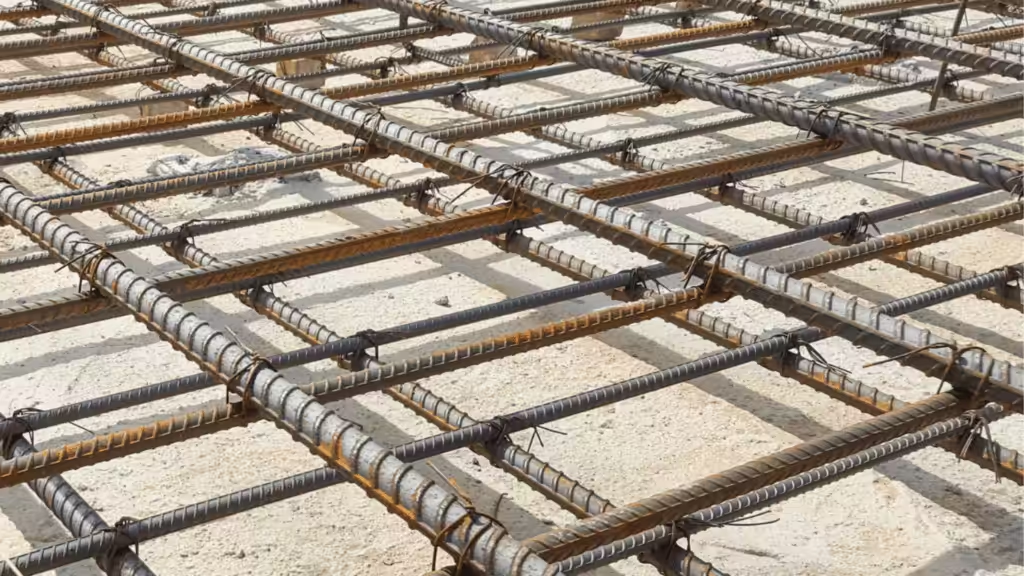
Apply a 0.30 or 0.40 grade on which you will place a polyane sheet over the entire surface. Next, you will need to install a 6 mm steel welded mesh. The mesh sheets must be joined together using wire or welded to provide resistance to the pool base.
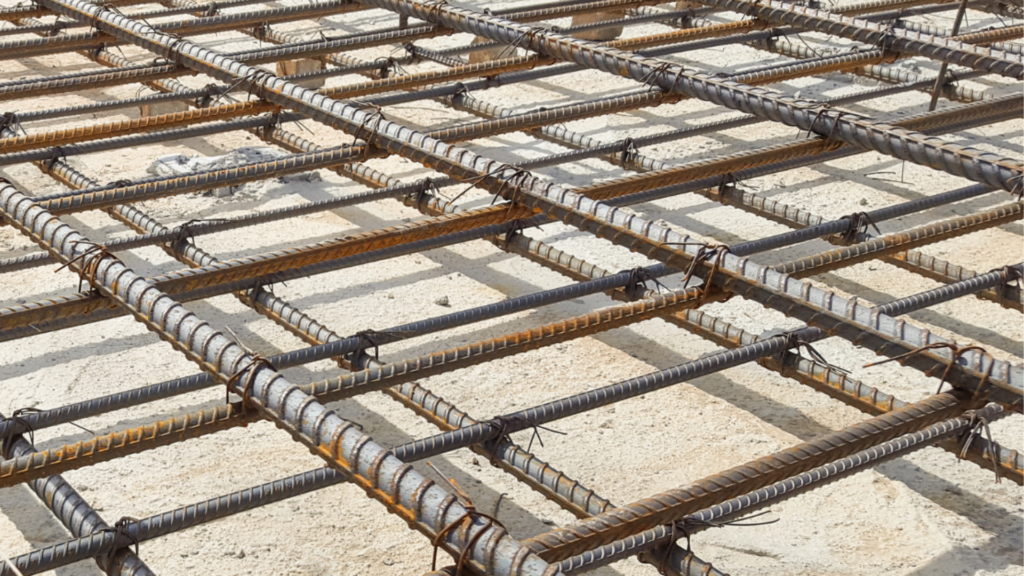
Finally, provide an 8 mm steel strip footing all around the location of the future cinder blocks. Also, be sure to leave vertical steel bar pieces (50 cm) where you will install reinforcement posts.
A key step not to be overlooked: the installation of a hydrostatic relief valve well. This well, placed on a bed of stones, will consist of a polyethylene pipe with a diameter of 300 or 400 mm, whose function is to drain rainwater or condensation.
It is crucial that this water does not stagnate behind the pool structure. A pump, such as a drainage pump, will be installed in the pipe to progressively remove this water.
🛟 Good to know: don’t forget to saw the welded mesh around the main drain, which will then be mounted with its glued pipe and sealed with mortar.
Concrete slab for the inground pool
Let the slab dry for at least 10 days. Once dry, you can begin laying the blocks.
Two construction options are available to you:
Traditional block construction – Cinder blocks
It is important to place stiffeners every 1.80 meters as well as at each corner of the pool.
It should be noted that this information may differ depending on the size and shape of the pool.
Specific stiffening post blocks are commercially available. These blocks are mainly used for flat-bottomed pool constructions. Regarding corner or post blocks, a metal reinforcement must be attached to the rebars prepared on the slab, and it must be continuous to the top of the wall.
In parallel with the wall assembly, it is necessary to install the various parts to be embedded. Depending on the depth of the pool, one to two horizontal bond beams must be laid. For this, there are bond beam blocks as well as bond beam reinforcements. These must travel the full perimeter of the structure without any interruption.
Construction with shuttering blocks
This type of construction uses shuttering blocks (hollow blocks). This material is specifically intended for the construction of pools with a non-flat bottom. These blocks are hollow and are set in an offset manner. Reinforcements must be placed both vertically and horizontally at each row of blocks. Shuttering blocks are assembled dry, meaning without using mortar.
It will then be necessary to fill them with concrete that will be vibrated so that the concrete properly reaches the bottom of the walls and no air bubbles remain.
 Tablier PVC seul
 Coffret Alimentation 24V Hors Sol
 Coffret Alimentation 24V Immergé
 Contacteur à clé
 Télécommande
 Bouchon à coller PVC
 Capuchon de lame PVC
 Sangles et attaches de piscine
 Turbine de nage – Intégrée
 Turbine de nage – Saillie amovible