


All our articles
Swimming pool assembly guide: steps and advice
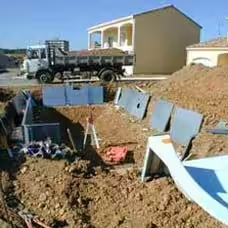
Swimming Pool Installation Guide
Why choose a metal panel pool kit?
Here are the main advantages:
- Remains flexible and allows for compensation of natural ground movements and earth pressure on the walls,
- Does not crack; the structure will not lift if you drain the water,
- Does not require major works for installation (minimal concrete), thus preserving your garden,
- Allows you to install it yourself,
- Resistant to rust. After several years, when replacing the liner, some corrosion may appear on certain panels, but it is easily treated by sanding and applying a galvanizing product.
A metal structure must be connected to the ground (earthing).
Guide to assembling a swimming pool from a metal panel kit

Installing a pool from a kit
A metal panel pool kit stands out from other construction methods due to its simplicity of installation, assembly speed, resistance to bad weather and ground movement, as well as its perfect watertightness ensured by a liner or reinforced PVC.
Depending on your skills, installing a pool can be done by two people in a few days or take several weeks.
No specific skills are required, but being a good DIYer is recommended.
You will save a significant amount of money once the project is finished.
We will detail the assembly of a standard pool kit, from earthworks to the final filling.
For an overview of the pool kit assembly steps, we recommend watching these two videos:
Pool kit assembly video Part 1:
In this video, the pool kit is installed on a hangar’s concrete slab as an example. In your excavation, it is not necessary to fix each panel on a full concrete slab. Concrete pads at the supports are sufficient to stabilize the entire structure. The pool floor can be made with a 7-8 cm lean screed, without the need for mesh.
Pool kit assembly video Part 2:
Pool location, choice of shape and bottom, kit selection
The choice of location must take into account sunlight, prevailing winds, proximity to neighbors, and urban planning regulations (legal distances from neighboring properties can be checked with the municipal technical services). The ideal site is flat, not overlooked, free of rocks or water, and must have an access wide enough for an excavator to pass.
The choice of shape is very subjective. All configurations are possible for kit pools. We recommend opting for a simple shape (square or rectangle) to facilitate coverage (automatic cover
or tarp
) as well as cleaning (pool robot
).
Regarding the pool floor: avoid excessive depth (maximum 190 cm for an 8 x 4 m size). If it is too deep, it will take more time and volume to heat naturally, unless you plan for a water heating system
.
Choose a flat bottom (more practical for children playing with a ball), slightly sloped or dome-shaped, or a “diamond point” (or “truncated pyramid”) which allows for a shallow area and easy access to the bottom all around the pool.

Select a metal pool kit whose components are rigid enough, do not deform, and do not show waves. The panels are connected by bolts and equipped with supports (or A-feet) at the back, ensuring excellent stability and allowing them to resist soil or water pressure.
A custom liner
adapted to the exact dimensions of your pool floor will be necessary. Installation will be explained later via images. Another option for optimal watertightness is to install a reinforced PVC lining. This task must be carried out by a professional.

Before starting the construction of a pool, it is essential to correctly choose the location
, plan the access
for construction machinery, and define the location of the technical room
.
You will be required to submit a declaration of works to the municipal services.
ensure you respect a minimum distance between the pool and neighboring properties or public roads.
To be submitted at the town hall
Choosing the pool location
Identify the best orientation for your pool. It is advisable to choose the sunniest location. Take into account the prevailing wind direction and place the skimmer in that direction to facilitate the collection of floating debris.
Check the ground type; a pool cannot be installed on backfilled earth, as this could lead to subsidence or a lack of stability.
Be vigilant about underground networks; damaging an underground line or piercing a pipe could be problematic.
Choose the pool location carefully
If the sun does not reach the pool, the water will not heat up enough. You will be forced to settle for cool water or consider a heating system.

select the right location for your pool

A location too close to a road can lead to noise and dust. Ensure that nearby trees (especially conifers) do not drop debris into your pool and do not damage the linings and covers!
Site Access
The simpler the site access, the easier the construction will be. Plan for the arrival of a mechanical shovel, essential for the earthworks and excavation of your future pool.
Caution with construction machinery!
A steep slope can prevent the mechanical shovel from climbing: it will be necessary to allow for its passage before starting to dig!

Next page: List of required items
 Tablier PVC seul
 Coffret Alimentation 24V Hors Sol
 Coffret Alimentation 24V Immergé
 Contacteur à clé
 Télécommande
 Bouchon à coller PVC
 Capuchon de lame PVC
 Sangles et attaches de piscine
 Turbine de nage – Intégrée
 Turbine de nage – Saillie amovible