


All our articles
Changing the sand in your pool’s sand filter: when and how
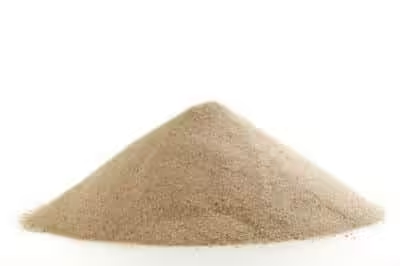
The cleanliness of your swimming pool water depends largely on the efficiency of your filter. Its sand is responsible for draining and capturing small impurities from the water, thus keeping your pool clear and crystal-clear for a long time.
Why replace your filter sand?
 Over time, filter sand wears out due to abrasion and constant contact with water, resulting in decreased density and a reduced ability to trap impurities. Furthermore, prolonged use leads to clogging: debris accumulates and obstructs the filtration system, especially when the water contains a lot of limescale. This also fixes itself onto the sand, forming compact blocks: the sand eventually coagulates and becomes ineffective. It is recommended, when the water is very hard, to opt for preventive anti-limescale treatments to protect the filter.
An imbalance in the water’s pH or a poorly executed treatment can also promote scale formation. Over time, the sand can turn into a single solid block inside the filter, requiring replacement. This is why it is preferable to regularly check the condition of your sand, rinse it, and replace it when necessary.
Which type of filter to choose?
There are several models of pool sand filters. They all work on the same principle and have the same filtration capacities. However, they differ in their ergonomics and ease of access for maintenance operations: a filter with a side valve will take up more space in your technical room, but a large lid will facilitate access to the sand, while a more compact top-valve filter will require removing the valve to access the sand. Also, note that some side-valve filters have a transparent dome, which is very useful for checking the sand’s condition and deciding if it’s time for maintenance.
Pool filter maintenance
Regular maintenance
Frequent filter cleaning helps prolong the lifespan of your sand. Backwashing reverses the water circulation using a control on the filter valve. Chemical cleaning is also recommended to descale the filter and extend its longevity.
While these cleanings can help extend the use of your sand, it may nevertheless be necessary to add more sand every 2 to 3 years. In this case, choose a sand with a similar grain size, generally between 0.5 and 1.2 mm, to top up the filter load, and make sure to use special pool-grade sand!
When to replace your filter sand?
In general, sand should be completely replaced every 3 to 5 years, but this can be up to 7 years if your filter is well-maintained regularly and if your water is not too heavy in limescale. However, if you notice sand leaks in the pool or if the water appears cloudy without the pH being at fault or an excessive amount of chemicals being used, it may be time to change the sand.
To be certain, perform a backwash of the filter and check the flow rate at the return nozzles: if it is too weak, it is likely that the sand needs replacing. Additionally, if you observe green coloration or algae in your pool despite proper treatment, this may also indicate the need to change the sand.
It is essential to perform appropriate treatments. If you have a side-valve filter with a transparent dome, check the condition of the sand to determine if there is calcification. It should be fluid and not compacted into hard blocks. Otherwise, especially if you haven’t performed regular cleanings or if the last sand replacement was more than five years ago, it is probably time to change your filter sand!
Steps to replace filter sand
Replacing your pool filter sand can be laborious, especially if you are not a handyman; in that case, don’t hesitate to call a professional!
- First, drain the filter after stopping the filtration and closing all valves to avoid flooding your technical room (if it is buried or semi-buried, you could even completely empty your pool!). To do this, connect the filter drain plug to a sewer or a hose, or use a water vacuum. Then leave the filter to dry for several hours.
- To access the sand, open the filter. For a side-valve filter, turn the upper tube and the diffuser. Then remove the sand using a container, taking care not to damage the laterals at the bottom of the tank. You can also use a vacuum cleaner suitable for rubble and water, or tilt the tank on its side to completely empty the filter; ideally, you should then rinse it with a water hose.Inspect the condition of the laterals arranged in a star pattern at the bottom of the filter, which are often responsible for releasing sand into the pool, and replace them if necessary.
- Before refilling the filter, make sure you have put it back in place correctly. Replace the drain plug, block the water inlets and outlets with plastic bags, and cover the laterals with water to cushion the falling sand and prevent the inhalation of dust. Next, pour the sand into the tank (starting with one third of coarser sand before continuing with fine sand), gradually adding water.Do not exceed 2/3 of the tank to preserve the necessary space for water movement.
- Next, remove the protection from the pipes and close the filter. Set the valve to the rinse position and perform a backwash to prevent dust from settling in the pool before restarting the filtration.
Although replacing the sand may seem a bit tedious, it ensures that your water remains clear; do not ignore it and do not hesitate to call a professional if it seems too difficult for you!
 Tablier PVC seul
 Coffret Alimentation 24V Hors Sol
 Coffret Alimentation 24V Immergé
 Contacteur à clé
 Télécommande
 Bouchon à coller PVC
 Capuchon de lame PVC
 Sangles et attaches de piscine
 Turbine de nage – Intégrée
 Turbine de nage – Saillie amovible