


All our articles
Pool cleaner maintenance: 5 tips
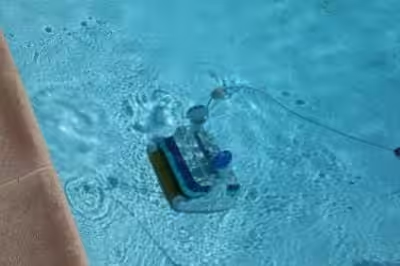
Tips for maintaining a pool robot
⟨1/⟩A pool robot allows you to enjoy your pool while reducing the time spent on its maintenance. However, an efficient model represents a significant cost, and its ⟨2⟩average lifespan is only 8 years… ⟨/2⟩ By taking care of it and maintaining it regularly, you can ⟨3⟩increase its longevity by several years⟨/3⟩, while avoiding sometimes costly repairs. All you need to do is follow a few common-sense recommendations and regularly check the condition of certain components of the robot that are particularly sensitive to wear and tear.
- After each use, once the robot is out of the water and turned off, be sure to carefully empty the filters, rinse them with clean water, and let them dry before putting them back in place. Also rinse the filter plate to ⟨4⟩remove any residue.⟨/4⟩
- ⟨5⟩Frequently check the condition of the brushes⟨/5⟩ of the robot. If their foam is damaged (or if the wear indicator is reached for PVC brushes), it is necessary to replace them to ensure optimal mobility of your device. Generally, foam brushes are changed after each season, while PVC ones must be replaced every two seasons, but depending on usage conditions, more frequent replacement may be necessary.
- Other elements must be checked regularly: make sure the propeller is not blocked, that the transmission belts are not overstretched, and that the tracks are not loose (or that the tires are not too worn if your model is equipped with them). ⟨6⟩Replace damaged parts as needed⟨/6⟩ and remember to always change both tracks at the same time to maintain the robot’s balance.
- Use the handle to handle the robot and remove it from the pool, use a pole if necessary when it is at the bottom, and ⟨7⟩move it by gently pulling on the cable⟨/7⟩ if needed. If this cable is damaged, it would compromise the proper functioning of the device.
- If a lot of debris has accumulated in your pool, consider removing it manually with a net or a brush before starting your robot to preserve its efficiency!
- Pay attention to how the device is stored: remove it from the water once its work is finished, ⟨8⟩store it away from the sun and humidity⟨/8⟩, on its caddy, carefully untangling the cable after each use. Never store it without having thoroughly cleaned and rinsed it, especially at the filter block level, as dry debris can be difficult to remove later.
- The robot must release the air it contains when submerged. Therefore, remember to ⟨9⟩submerge it slowly in the water⟨/9⟩ to allow air to escape and ensure efficient operation.
- Check the water temperature before submerging the robot in the pool. It does not handle low temperatures well, and ⟨10⟩it generally should not be used in water below 10 degrees⟨/10⟩.
- Regularly checking the pH and chlorine levels of the water not only preserves the water quality for swimmers but also protects the pool equipment, specifically your robot. If you perform a chlorine shock treatment to treat an algae bloom or after a period of absence, ⟨11⟩wait until the chlorine level has returned to normal⟨/11⟩, i.e., below 3mg/l, before starting the robot.
- The robot must never be turned on outside of the water. Therefore, wait until it is completely submerged before turning it on to avoid any damage.
If you follow these few maintenance recommendations and regularly replace worn parts, you should keep your pool robot in good working order for a long time, allowing you to get a return on an investment that, while it may seem secondary, will be useful daily and contribute greatly to the comfort of your pool!
 Tablier PVC seul
 Coffret Alimentation 24V Hors Sol
 Coffret Alimentation 24V Immergé
 Contacteur à clé
 Télécommande
 Bouchon à coller PVC
 Capuchon de lame PVC
 Sangles et attaches de piscine
 Turbine de nage – Intégrée
 Turbine de nage – Saillie amovible