


All our articles
Pool salt quantity: complete guide
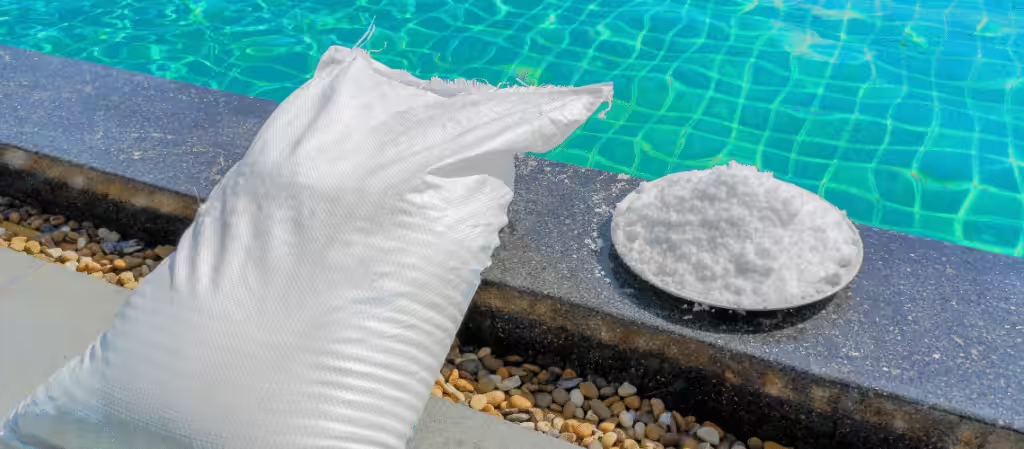
Do you have a salt pool and want to know how much salt to add to your pool water? Here is a very simple calculation method to help you!
Salt Pool: Guide to equivalences and calculation methods
- Volume: 1 m3 = 1,000 L of water
- Salt level: 1 g/L = 1 kg/m3
- Quantity of salt (kg) = Volume of water (m3) X salt level (kg/m3)
Why add salt to my pool?
The salt chlorinator is an automatic disinfection device for swimming pools. It naturally converts the salt present in the water into disinfectant chlorine. This is commonly known as a “salt pool”. This treatment system has the advantage of being automatic and guaranteeing a much higher water quality than that obtained by traditional methods using chlorine tablets.
For the salt chlorinator to work properly, it is therefore important to add a small amount of salt to the pool water. The salt level is expressed in g/L, which indicates the quantity of salt in grams per liter of water. In reality, the quantity of salt required is quite low, around 4 g/L (this can vary depending on the equipment). For comparison, the salt level in seawater is around 35 g/L.
Does pool water taste like seawater?
Don’t worry, salt pool water will never have the salty taste of seawater! To convince yourself, simply mix 0.8 grams of salt in a 200 ml glass of water and taste the mixture. This represents exactly a salt concentration of 4 grams per liter.
How to determine the amount of salt needed?
As you will see, the calculation is quite simple. It depends on the salt concentration required by the chlorinator and the volume of water in the pool.
- Salt concentration is indicated in g/L or kg/m3
- Pool water volume is expressed in L or m3
1. Calculate the water volume in m3
Given the large volume of water in a pool, it is more common to use the cubic meter (m3) unit. The equivalence is 1 m3 = 1,000 L of water.
If you have an above-ground pool, the manufacturer may use the liter unit, in which case you will need to convert the pool water volume into cubic meters for simplicity. To do this, just divide the volume of water in liters by 1,000 to get the water volume in cubic meters (m3). For example, for a 22,500 L pool, this gives 22.5 m3 of water.
2. Calculation of the salt level in kg/m3
To simplify further, we will convert the salt level from g/L to kg/m3. The equivalence is 1 g/L = 1 kg/m3, so 4 g/L = 4 kg/m3, 6 g/L = 6 kg/m3, etc.
3. Calculation of the quantity of salt for a given water volume
We now have a volume of water (in m3) and a salt concentration (in kg/m3). Now simply multiply the water volume by the desired salt concentration to get the required amount of salt in kg.
Quantity of salt (kg) = Volume (m3) X Salt Level (kg/m3)
Let’s take an example: a 50 m3 pool and a chlorinator that operates at 4 g/L, or 4 kg/m3. The calculation is as follows: 50 x 4 = 200 kg of salt required.
How to adjust the salt level in the pool?
If your water is already slightly salty and you need to add salt, the calculation will be slightly different:
- To start, you must measure the salt level in the water using a strip.
- First, measure the salt level in the water using a measuring device or an electronic tester.
- Subtract the result obtained from the required salt level in the water. For example, if you need 4 g/L and your measurement indicates 2.5 g/L, the calculation is: 4 – 2.5 = 1.5.
- You are therefore missing 1.5 g/L of salt, which corresponds to 1.5 kg/m³.
- For a 50 m³ pool, the calculation becomes: 50 x 1.5 = 75 kg. So, for this example, you will need to add 75 kg of salt to the water.
How many bags of salt should I plan for?
Salts are generally sold in 25 kg bags. To determine the number of bags needed, divide the total weight of salt by 25 and round up to the nearest whole unit. In our two previous cases:
- For a total of 200 kg of salt: 200 ÷ 25 = 8, which gives 8 bags of 25 kg.
- For a total of 75 kg of salt: 75 ÷ 25 = 3, which means 3 bags of 25 kg.
Does the salt need to be renewed every year?
No. Salt has the advantage of not evaporating with the water, which means that in theory, it can stay indefinitely in the pool. However, in practice, there is always a small loss due to splashing, filter washing, or during winterizing the pool. It is therefore advisable to check the salt level at the beginning of each season and add salt if necessary.
| Pool Volume | Salt Level 3 g/L (3 kg/m³) | Salt Level 4 g/L (4 kg/m³) | Salt Level 5 g/L (5 kg/m³) | Salt Level 6 g/L (6 kg/m³) |
|---|
| 10 m³ (10,000 L) | 30 kg → 2 bags | 40 kg → 2 bags | 50 kg → 2 bags | 60 kg → 3 bags |
| 20 m³ (20,000 L) | 60 kg → 3 bags | 80 kg → 4 bags | 100 kg → 4 bags | 120 kg → 5 bags |
| 30 m³ (30,000 L) | 90 kg → 4 bags | 120 kg → 5 bags | 150 kg → 6 bags | 180 kg → 8 bags |
| 40 m³ (40,000 L) | 120 kg → 5 bags | 160 kg → 7 bags | 200 kg → 8 bags | 240 kg → 10 bags |
| 50 m³ (50,000 L) | 150 kg → 6 bags | 200 kg → 8 bags | 250 kg → 10 bags | 300 kg → 12 bags |
| 60 m³ (60,000 L) | 180 kg → 8 bags | 240 kg → 10 bags | 300 kg → 12 bags | 360 kg → 15 bags |
 Tablier PVC seul
 Coffret Alimentation 24V Hors Sol
 Coffret Alimentation 24V Immergé
 Contacteur à clé
 Télécommande
 Bouchon à coller PVC
 Capuchon de lame PVC
 Sangles et attaches de piscine
 Turbine de nage – Intégrée
 Turbine de nage – Saillie amovible