


All our articles
Natural pool: biological swimming
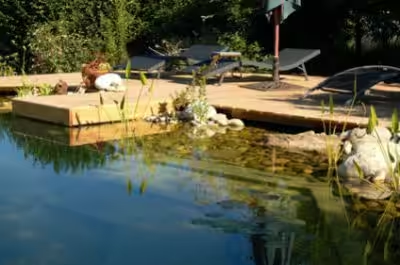
The natural pool: biological swimming

More and more people are opting for a natural pool to enjoy an ecological and charming water feature during the summer season.
What does such a layout look like? What are the benefits and drawbacks of such an installation compared to a traditional swimming pool?
Ecology and aesthetics
A natural pool is a concept that relies on biological elements to perform filtering, usually handled by pumps and chemicals. The ecological advantage is undeniable, as plants take care of water purification. In general, a natural pool is divided into three zones of equivalent surface area:
- a swimming zone
- a regeneration zone
- an oxygenation zone (such as a waterfall)
Water circulates between these zones thanks to a discrete pump, but the architecture of the pool also utilizes gravity.
A natural pool also adds significant aesthetic value to your garden, with beautiful green hues that catch the eye.
Is it complicated to build a natural pool?
Well no, it’s not very complicated. You will not need a building permit, only a prior declaration of works to be submitted to your town hall. Therefore, you will not see your property tax increase.
Some knowledge of electricity will prove necessary to ensure that the pump operates correctly and is watertight. Masonry work is a bit more demanding than for a classic pool: several basins must be dug, separated by walls. It is also possible to opt for a natural pool kit, but this will be more expensive.
Which plants to choose for my natural pool?
Filtration relies on a living element, specifically plants, which makes your pool entirely ecological. You will need three different types of plants:
- purifying plants, intended to filter the water
- regenerating plants, to fight bacteria and oxygenate the water
- ornamental plants, such as water lilies, to inhibit the proliferation of algae.
How to maintain your natural pool?
Unlike a traditional pool, you won’t have to drain it, only compensate for the natural evaporation of water. You will also need to maintain your plants regularly, but all the necessary products are easily accessible online. You can also find robots there to clean the swimming basin of your pool.
What are the disadvantages of a natural pool?
Such a project requires an initial investment of at least €20,000, taking into account construction costs, electricity, and the purchase of plants. A classic pool can be found starting at half that amount, or even less. However, a natural pool generates no property tax costs and has very limited maintenance costs: anticipate about €750 in electricity expenses per year (for the robot and the pump), and a few liters of water to compensate for evaporation. Furthermore, a natural pool warms up thanks to solar energy, which is free.
In short, a natural pool is a significant investment at the start, but one that pays off in the long term, while offering you moments of relaxation, with respect for the environment!
 Tablier PVC seul
 Coffret Alimentation 24V Hors Sol
 Coffret Alimentation 24V Immergé
 Contacteur à clé
 Télécommande
 Bouchon à coller PVC
 Capuchon de lame PVC
 Sangles et attaches de piscine
 Turbine de nage – Intégrée
 Turbine de nage – Saillie amovible