


All our articles
Standard NF P90-306 on swimming pool barriers and fences: details
What is the content of the NF P90-306 standard?
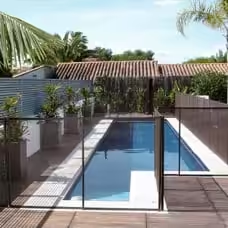
This standard concerns safety barriers aimed at restricting access to in-ground swimming pools
that are not fenced for private or collective use, in order to protect children.
However, these devices can also be used to secure above-ground pools.
The pool safety barrier must be designed to prevent access by children under 5 years old
by climbing, stepping over, or accidental opening of the access points.
To allow safe passage for older users, it is necessary for the barrier to include a means of access
secured against children under 5 years old and that is safe for all users, whether adults or children.
Main safety aspects stipulated in the standard
- The minimum height
between the highest foothold and the lower part of the top level of the barrier must always be at least 1.10 m. - The bars must not have rough surfaces.
- Edges, metal wires, spikes, ridges, protruding elements, and corners must not present risks of injury, cutting, or piercing.
- The protective barrier and its means of access
must not cause injury to children attempting to cross them: entrapment risks must be avoided. - To prevent children under 5 years old from unlocking the barrier or opening it inadvertently, the unlocking mechanism must require at least two actions to be released. The system must be easy for an adult to use.
- The barrier, posts, and means of access must be able to withstand impacts equivalent to a weight of 50 kg.
When is it advisable to choose this safety solution?
It is recommended when the pool is located in an easily accessible open space
.
With a minimum height of 1.10 m
, it constitutes a physical barrier to prevent children under 5 years old from approaching the pool. Its gate must be equipped with an opening system that young children cannot operate.
Discover all our pool safety barriers
The elements mentioned above are provided for informational purposes. They are not exhaustive and do not replace the regulations in force.
For any further information, consult the texts or contact the DDE or the DDCCRF.
[/p]
 Tablier PVC seul
 Coffret Alimentation 24V Hors Sol
 Coffret Alimentation 24V Immergé
 Contacteur à clé
 Télécommande
 Bouchon à coller PVC
 Capuchon de lame PVC
 Sangles et attaches de piscine
 Turbine de nage – Intégrée
 Turbine de nage – Saillie amovible