


All our articles
guide you step by step through this stage
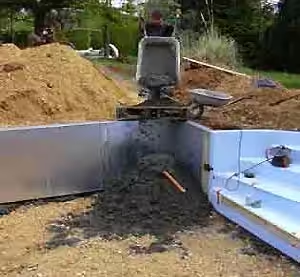
The structure has now been improved, with slope markers and the installation of plumbing. The concrete will reinforce the robustness of the structure to withstand soil pressure.
This is a crucial step, as the quantities of concrete required depend on the dimensions of the pool.
The concrete is poured to cover the A-supports (braces), the base of the panels, and the deck supports.
It should not be too liquid and should be fairly dense. For example, a pile of concrete placed on the ground should maintain its shape. If it is too wet, it may slip under the panel (which should be avoided).
The concrete must properly encase the base of the A-supports. Furthermore, concrete that is too soft would exert pressure on the panels, risking displacement and misalignment.
The concrete can be poured directly from the truck using a pump, or, in most cases, using a wheelbarrow.
Unload the wheelbarrow gradually by shaking it, not by dumping it all at once. Indeed, the weight of the concrete can alter the alignment and level of the walls.
The “person with the shovel” can also help distribute the concrete directly around the A-supports, thus facilitating the work.
About two wheelbarrows of concrete are needed for each A-support. For the panels, it is recommended to place the concrete at the base up to a height of 30 cm and at a distance of 45 cm.
At this stage, it is essential to check two essential qualities: horizontal alignment and straightness of the walls.
Minor adjustments can still be made. Once the concrete has hardened, it is impossible to make modifications.
After concreting the perimeter, the next step will be to create the pool floor screed.
The Floor Screed
The strength of the pool relies on its own metal structure. The concrete screed has no structural function; it simply stabilizes the ground and ensures a uniform surface.
The average thickness of the screed varies from 7 to 10 cm, depending on the quality of the excavation.
This layer of concrete can be poured after the perimeter concrete has hardened. This reduces the risk of misaligning the panels while working from inside the pool.
However, it is possible to concrete the interior at the same time as the pool perimeter. It is crucial to ensure not to shake the already concreted walls. Remember that the concrete is not yet completely hardened.
For the interior of the basin, use a mortar that is not too liquid (mixed at 300 kgs/m3) so that it can adhere to sloped surfaces.
The concrete is poured into the pool and then distributed with a shovel over the bottom and slopes.
Use a rake to level it according to the stakes and strings. Using a trowel and a straightedge, even out the mortar.
You can now place the stakes below the mortar surface. Simply level the mortar without smoothing it, as the bottom liner will adhere better to a rough surface. Adjust the concrete to the height of the reference line at the bottom of the wall all around the pool. This will ensure a straight transition for the finishing coat.
Ensure that the concrete level around the main drain (floor drain) allows for the application of the finishing coat (approximately 2 cm).
When the main concreting is complete, take the necessary time to clean all splashes on the walls and steps. Once hardened, concrete is difficult to remove.
 Tablier PVC seul
 Coffret Alimentation 24V Hors Sol
 Coffret Alimentation 24V Immergé
 Contacteur à clé
 Télécommande
 Bouchon à coller PVC
 Capuchon de lame PVC
 Sangles et attaches de piscine
 Turbine de nage – Intégrée
 Turbine de nage – Saillie amovible