


All our articles
Installing a hot tub at home: the complete guide
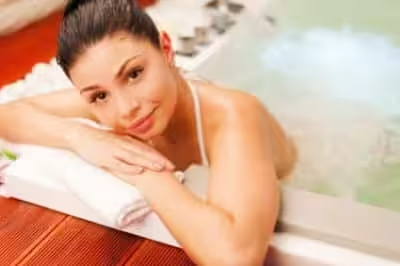
Installing a home spa
⟨1/⟩
Having a SPA at home is a dream: enjoying a hot tub at the end of the day, ⟨2⟩treating yourself to a moment of well-being⟨/2⟩ whether alone, as a couple, or with friends, or even relaxing your muscles after intense physical exercise. Once reserved for a privileged few, ⟨3⟩the home SPA is becoming more accessible⟨/3⟩, but as they are often personalized, they remain costly and their installation requires some thought. Here are a few tips to help you make the right decisions.
The basics for installing a SPA at home
Beyond aesthetics and comfort, the ideal location for setting up your SPA must meet clear ⟨4⟩safety and maintenance standards⟨/4⟩.
Technical installations must be easily accessible to allow for eventual maintenance. It is essential to have water and electricity inlets that comply with current regulations, as well as a necessary drain for water renewal. While you can handle some of the work yourself, ⟨5⟩do not hesitate to consult an expert to guarantee the compliance, and thus the safety, of your installation⟨/5⟩.
Indoors, an ⟨6⟩efficient ventilation system⟨/6⟩ such as a VMC (controlled mechanical ventilation) or a VMI (inverted mechanical ventilation) is also essential in the room where the SPA is located to avoid condensation problems. Similarly, floors and walls must be designed to be waterproof to withstand evaporation or splashes.
Indoor or Outdoor SPA?
The ⟨7⟩indoor SPA⟨/7⟩ has the advantage of being usable all year round and benefiting from decor and an atmosphere conducive to relaxation, with music or candles. Its location also makes it an ideal spot for beauty treatments, such as masks and facials. ⟨8⟩Be careful, however, that the floor can support its weight⟨/8⟩ (several hundred kilos), as well as that of the users.
An ⟨9⟩outdoor SPA⟨/9⟩ is favored by nature lovers, especially in the countryside or the mountains. ⟨10⟩Its installation is generally simpler and offers you the chance to enjoy the scenery⟨/10⟩, or even live a unique and invigorating experience by using a hot SPA in the snow with Nordic inspiration! ⟨11⟩Choose a stable and flat location⟨/11⟩, preferably sheltered from the wind, and consider adding a roof to protect yourself from the elements and enjoy your SPA regardless of the season.
The various types of SPA – What budget? What pros and cons?
There are several types of SPA, and your choice will be influenced by your budget, the complexity of the installation, the size, and the features you prefer. ⟨12⟩Be aware that the cost of setting up a home SPA can vary from 2,000 to 50,000 euros⟨/12⟩, so it is important to clearly define your expectations before starting!
- Built-in spa: integrated into the floor, it cannot be moved once installed. ⟨13⟩It requires an independent plumbing system and a technical room⟨/13⟩ for filtration and heating, thus requiring professional intervention. Its price varies depending on the size, options, and materials chosen.
- Portable spa: movable and more affordable, it does not require a technical room and only needs an electrical connection and a water inlet.
⟨14⟩It is possible to install it yourself⟨/14⟩ and change its position outdoors according to the seasons. The cost also varies based on dimensions, materials, and options chosen, and can range from 4,000 to 20,000 euros.
- Swim spa: it combines relaxation and ⟨15⟩the ability to swim against the current⟨/15⟩ in a pool several meters long thanks to powerful jets. This type of spa requires considerable space and represents a higher investment, which can reach 50,000 euros.
Inflatable SPA, the option for smaller budgets
⟨16⟩The inflatable SPA is the most economical and flexible solution⟨/16⟩: you can install it without needing a professional simply by inflating its PVC or nylon structure. Available in round, square, oval, or octagonal shapes and in various sizes, it can be used ⟨17⟩both indoors and outdoors⟨/17⟩ and even taken with you on vacation.
The inflatable spa represents a true democratization of balneotherapy, since ⟨18⟩a budget of 500 to 2,500 euros is sufficient⟨/18⟩ to enjoy a unique moment of relaxation at home with your family. You will also have the opportunity to practice water aerobics without difficulty.
However, be aware that the time required to heat the water is relatively long and the bubbles do not always have the same pressure as genuine massage jets.
 Tablier PVC seul
 Coffret Alimentation 24V Hors Sol
 Coffret Alimentation 24V Immergé
 Contacteur à clé
 Télécommande
 Bouchon à coller PVC
 Capuchon de lame PVC
 Sangles et attaches de piscine
 Turbine de nage – Intégrée
 Turbine de nage – Saillie amovible