


All our articles
Teaching your child to swim: our advice

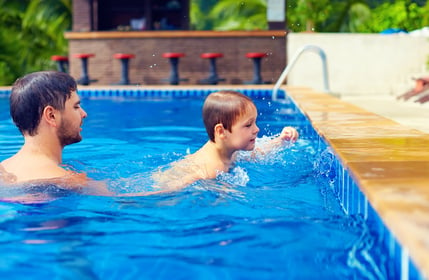 At what age should they start?
Many parents ask themselves the question: when is the best time to teach our child to swim? Pediatricians agree on a fairly vague answer: neither too early nor too late. If learning begins too early, the child risks being exposed too quickly to chlorine fumes, which can lead to respiratory problems such as asthma or chronic bronchitis. Conversely, if initiation takes place too late, the child could feel a sense of fear of the water and be deprived of the pleasure of swimming. Thus, 6 years old is often considered the ideal age, or even 5 years old, if the child seems comfortable in the bath and enjoys playing in the water.
Essential equipment
Before diving into learning, it is crucial to obtain the right equipment, allowing the child to discover swimming while having fun, and in an optimal safety setting. You will need to equip yourself with a kickboard and a flotation belt, as well as one or two foam noodles. With the right equipment, the child will be ready to enter the deep end!
Helping them appreciate the water
Initiation can be divided into two stages.
The first phase consists of accustoming the child to the water, and eventually helping them to overcome their fear of water. To do this, give them the necessary time to adapt, observe if they like touching the water, play with light splashes and, little by little, let them climb down the ladder into the pool alone. Once in the water, encourage them to take initiative to build their confidence, for example by suggesting they go around the pool while holding onto the edges, or by submerging their head for a few seconds to master their breathing.
Teaching them fundamental movements
If they feel comfortable in the water, it is now time for them to learn to float and move around. To begin, place two noodles under each of their arms and let them lie on their back. Gradually, remove these accessories and encourage them to float on their back all by themselves.
Learning propulsion can be done using the pool walls: where the water level is low, have them jump and show them how to propel themselves by pushing against the side walls.
Finally, introduce them to the basic swimming movements. By supporting themselves with the kickboard, they will need to kick their legs to reach the other side. Gradually, remove this accessory and let them swim freely with “doggy paddle” movements. This is an excellent introduction to breaststroke, which represents the final stage of their learning.
Without ever rushing, always staying close to the child and ready to intervene, you should succeed in teaching them how to swim. For some, however, this process may take more time; without making the child feel guilty, it is better to entrust them to trained professionals, lifeguards who will know how to better support them.
Even if your child has learned to swim, it is essential to remain vigilant and to put in place swimming pool safety devices (such as immersion alarms, safety covers, or immersion alarms) in case of a fall.
 Tablier PVC seul
 Coffret Alimentation 24V Hors Sol
 Coffret Alimentation 24V Immergé
 Contacteur à clé
 Télécommande
 Bouchon à coller PVC
 Capuchon de lame PVC
 Sangles et attaches de piscine
 Turbine de nage – Intégrée
 Turbine de nage – Saillie amovible